































































































































































Stenography is a specialized method of writing that allows spoken words to be recorded much faster than conventional handwriting or typing. Instead of representing language one letter at a time, stenography uses abbreviated symbols, sounds, combinations and keystrokes to capture words and phrases efficiently. It is particularly important in court reporting, parliamentary proceedings, captioning, depositions, conferences and other situations where an accurate written record of spoken language is required in real time.
The principle behind stenography is relatively simple: the stenographer does not necessarily write every letter of every word. Instead, they use a system designed to represent sounds, syllables, words or groups of words with a small number of strokes or keystrokes. A trained stenographer can therefore record speech at speeds that would be extremely difficult using ordinary handwriting or a conventional keyboard.
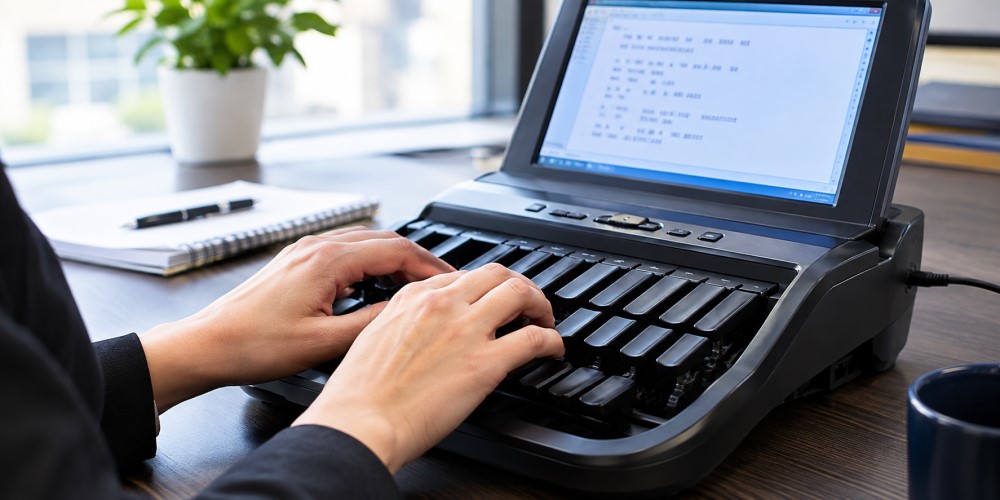
Modern stenography has evolved significantly from traditional shorthand writing. Today, stenographers commonly use specialized machines known as stenotype machines, which have fewer keys than a standard computer keyboard but allow several keys to be pressed simultaneously. Specialized software can then translate the resulting combinations into words and sentences.
What is stenography?
Stenography is a system of rapid writing designed to record spoken language quickly and accurately. The word is derived from Greek roots associated with narrow or compressed writing, reflecting the fundamental idea of representing language using fewer written elements. Traditional writing generally requires a person to write or type a sequence of letters. For example, the word “government” contains ten letters, and each letter has to be represented in normal writing.
Stenography approaches the same problem differently. Depending on the particular stenographic system, the writer may represent the word through a combination of sounds, shorthand symbols or simultaneous keyboard strokes. The objective is not simply to make writing shorter. The more important objective is to make it possible to keep up with natural human speech. People commonly speak at well over 100 words per minute, while everyday handwriting is considerably slower.
Professional stenographers therefore need a writing system capable of handling rapid, continuous speech. Stenography can refer both to shorthand writing systems and to the specialized techniques used by professional stenographers. In modern professional settings, the term is often associated with machine shorthand and court reporting.
How does stenography work?
Stenography works by compressing spoken language into a smaller number of writing actions. Rather than spelling words conventionally, a stenographer uses predefined combinations that correspond to sounds, syllables, words, phrases or other linguistic elements. The exact method depends on the stenographic system being used.
Traditional shorthand systems may use symbols and abbreviated forms written by hand, while modern machine stenography generally uses a specialized keyboard. In either case, the underlying principle is compression. For example, a conventional typist might need to press a separate key for each letter in a word. A stenographer using a stenotype machine can press several keys simultaneously to produce a single phonetic unit or shorthand entry.
Multiple combinations can therefore represent an entire word or phrase with far fewer physical actions. This is what makes stenography particularly effective for recording live speech. The stenographer is not trying to reproduce conventional spelling while someone is speaking. Instead, they are rapidly converting spoken language into a shorthand representation.
The basic principle of phonetic writing
Phonetic representation is one of the most important principles behind many modern stenographic systems. Instead of focusing exclusively on how a word is spelled, the stenographer focuses on how the word sounds. English presents a major challenge for conventional spelling because pronunciation and spelling do not always correspond directly. Words such as “through”, “though” and “thought” have different spellings but contain related sounds.
A phonetic shorthand system can avoid some of the unnecessary complexity created by conventional spelling. In machine stenography, a word may be represented using a combination of keys corresponding broadly to its sounds. The stenographer learns these combinations through extensive practice until they become automatic. This means that an experienced stenographer is effectively listening, interpreting and encoding speech at the same time. The process becomes increasingly automatic with training.
What is a stenotype machine?
A stenotype machine is a specialized keyboard designed specifically for rapid shorthand writing. Unlike a standard QWERTY keyboard, it contains a relatively small number of keys arranged according to the requirements of stenographic writing. The machine is designed so that multiple keys can be pressed simultaneously. This is called a chord, and a chord can represent a sound, syllable, word or phrase depending on the stenographic theory and dictionary being used.
The compact keyboard allows the stenographer to make very rapid combinations without moving their hands across a large keyboard. Modern stenotype machines may be electronic and can connect directly to computers or specialized software. Some professional systems include screens, storage, connectivity and other digital features, allowing the stenographer’s shorthand to be processed almost immediately.
Understanding the stenotype keyboard
The arrangement of a stenotype keyboard is fundamentally different from that of a conventional computer keyboard. Its keys are arranged around phonetic and linguistic functions rather than alphabetical order. A typical stenotype layout contains keys representing initial consonant sounds on the left and final consonant sounds on the right, with vowel keys positioned toward the center. The exact arrangement varies between systems and theories. A simplified representation looks something like this:
Initial sounds – vowels – final sounds
The left side can be used to represent the beginning of a word, while the central and right-hand portions help represent vowels and ending sounds. Because multiple keys can be depressed simultaneously, a single stroke can represent a substantial part of a word. The stenographer develops the ability to form these combinations instinctively.
What is a stenographic chord?
A stenographic chord is a group of keys pressed simultaneously to produce a particular shorthand entry. Chording is one of the central features that distinguishes stenotype writing from ordinary typing. Consider the difference between the two approaches. A conventional keyboard generally requires a sequence of individual keystrokes. A stenotype machine allows several relevant keys to be pressed together. The resulting combination is interpreted as one stenographic unit.
The stenographer therefore thinks less in terms of individual letters and more in terms of sound patterns and combinations. Chording also makes it possible to develop highly efficient shorthand for frequently used words and phrases. Common expressions can be assigned relatively simple combinations, reducing the number of physical strokes required.
How stenography records spoken language
The process begins when the stenographer listens to the speaker. Instead of consciously spelling each word, the stenographer identifies the sounds and linguistic units being spoken. The stenographer then enters the appropriate shorthand combination on the machine. The machine records those combinations, either electronically or through another recording mechanism. In a modern digital workflow, the shorthand entries are sent to specialized software.
The software compares each entry with a stenographic dictionary and determines the corresponding English word or phrase. For example, a particular chord might be associated with “the”, another with “government” and another with “because”. The software converts the shorthand entries into ordinary text. The stenographer can therefore create a readable transcript while the speech is still occurring.
The role of stenography software
Modern stenography increasingly depends on software that translates machine shorthand into conventional text. The software serves as an intermediary between the stenographer’s keystrokes and the final transcript. When a stenographer enters a chord, the software identifies the corresponding entry in a dictionary. If the combination is associated with a particular word, the software displays that word.
Professional software can also use contextual information, punctuation commands, phrase entries and user-defined dictionaries to improve transcription accuracy. The dictionary is particularly important because stenographic systems are highly customizable. A stenographer may create entries for technical terminology, names, legal expressions, medical vocabulary, company names and other specialized language. This allows the system to be adapted to different professional environments.
How real-time captioning works
One of the most visible applications of modern stenography is real-time captioning. A stenographer listens to live speech, enters shorthand into the machine and sends the resulting text to software that translates it almost immediately. The text can then appear on a screen for an audience. This technology is used in television captioning, live events, classrooms, conferences, public meetings and accessibility services.
In environments where people need immediate access to spoken information, real-time stenography can provide a valuable communication tool. The process is especially demanding because there is little opportunity to correct errors before the text is displayed. The stenographer therefore needs exceptional speed, concentration and accuracy.
How court reporting uses stenography
Court reporting is one of the best-known professional applications of stenography. Court reporters may be responsible for creating an official record of proceedings, including testimony, questions, answers, objections and other spoken material. Legal proceedings can involve rapid exchanges between judges, lawyers, witnesses and other participants. A conventional keyboard operator would find it extremely difficult to reproduce every spoken word in real time.
Stenography provides a practical solution by allowing the reporter to capture speech at high speed. The resulting shorthand is translated into readable text and may subsequently be reviewed, corrected and formatted as an official transcript. Accuracy is particularly important because court transcripts can become part of the legal record.
Why stenographers can write so fast
The speed of stenography comes from several principles working together. The first is simultaneous key pressing. The second is phonetic representation. The third is the use of abbreviations and predefined combinations. A conventional typist generally works sequentially: one character follows another. A stenographer can create a combination of several keys at once. The stenographer also does not necessarily need to represent every sound separately.
Frequently used combinations can be compressed into a single stroke, and common phrases can be represented by brief forms. Professional stenographers can therefore achieve extremely high writing speeds. Some trained stenographers are capable of recording speech at more than 200 words per minute, although the speed required varies according to the profession and circumstances. Speed alone, however, is not enough. A stenographer must also maintain a high level of accuracy.
What is stenographic theory?
Stenographic theory refers to the rules and principles that determine how spoken language is converted into shorthand. Different systems have developed their own theories, conventions and approaches. A theory establishes how consonants, vowels, sounds, word endings, prefixes, suffixes and common words should be represented.
The theory provides a foundation for learning the system, but professional stenographers eventually develop personalized dictionaries and shorthand forms that improve their efficiency. The goal is to create a system that is predictable enough to learn while flexible enough to handle the enormous variety of spoken language.
Stenography and punctuation
Stenography is not limited to recording words. Professional systems also provide ways to represent punctuation and formatting. A stenographer may use particular combinations to indicate punctuation marks such as periods, commas, question marks and quotation marks. Commands can also be used to indicate paragraph breaks, speaker changes and other formatting requirements.
In real-time captioning, punctuation is especially important because viewers need to understand the structure and meaning of the text immediately. Punctuation can sometimes be inferred from speech patterns, pauses and context, but professional stenographers also learn specific commands and techniques for entering punctuation efficiently.
How stenographers handle difficult words
One of the challenges of live transcription is dealing with words that are unfamiliar, technical or difficult to spell. These may include scientific terminology, medical names, legal expressions, foreign names and industry-specific vocabulary. Experienced stenographers prepare by studying the subject matter before an assignment. They may also build specialized dictionaries containing expected terminology.
Modern software makes this process considerably easier because custom entries can be added to a stenographic dictionary. Once an appropriate shorthand combination is associated with a term, the stenographer can enter it rapidly when it appears during the proceeding. Preparation is therefore an important part of professional stenography.
How stenographers deal with homophones
Homophones are words that sound alike but have different meanings or spellings. Examples include “right” and “write” or “there”, “their” and “they’re”. Because stenography can be phonetic, distinguishing between such words requires the use of context and specific shorthand conventions. A stenographer’s dictionary can contain different entries for words that sound similar, and the stenographer learns how to select the appropriate form. Context is also important when deciding which word belongs in a sentence. This illustrates why stenography is more than simply converting sounds into text. The stenographer must understand language and use contextual judgment.
What happens when a stenographer makes a mistake?
Errors can occur in stenography just as they can in conventional typing. The difference is that the consequences may be more significant when the stenographer is creating an official record. Professional stenographers therefore develop techniques for correcting errors quickly without losing track of the speaker.
In some systems, special shorthand commands allow the stenographer to delete or correct an entry. Digital software can also assist with editing and transcript production after the proceeding. For official transcripts, the raw output may undergo proofreading and quality control before the final document is released.
The difference between stenography and conventional shorthand
Stenography and shorthand are closely related but are not necessarily identical. Shorthand is a broad term covering systems designed to abbreviate writing, while stenography generally refers to rapid writing techniques specifically suited to recording speech. Some shorthand systems are handwritten.
Examples historically include systems based on geometric symbols or modified letters. Machine stenography differs because it uses a specialized keyboard and simultaneous keystrokes. Both approaches share the same fundamental objective: reducing the amount of writing required to represent spoken language.
The skills required to become a stenographer
Becoming proficient in stenography requires considerably more than learning where the keys are located. The learner must develop several abilities simultaneously. The first is knowledge of the stenographic theory. The second is keyboard coordination. The third is phonetic recognition. The fourth is listening comprehension. Finally, the stenographer must develop speed and accuracy through extensive practice.
A beginner may initially struggle to translate even slow speech. With repeated practice, however, common combinations become automatic. Eventually, the stenographer can listen to speech and enter shorthand without consciously thinking about every individual keystroke. This progression is similar to learning touch typing, except that the cognitive demands of stenography are considerably more complex.
How long does it take to learn stenography?
The time required to learn stenography varies considerably depending on the system, training method, learner and professional goal. Learning the basic keyboard and theory can be accomplished relatively quickly, but reaching professional speeds requires much more practice. Court reporting and real-time captioning demand particularly high levels of accuracy and speed.
Students commonly spend substantial amounts of time practicing dictation. They may begin with slow speech and gradually increase the speed as their accuracy improves. The objective is not to achieve speed at the expense of accuracy. A shorthand system becomes useful professionally only when the stenographer can maintain reliable accuracy at practical speaking speeds.
Why accuracy is as important as speed
High speed attracts considerable attention when people discuss stenography, but professional stenography is fundamentally about creating an accurate record. A stenographer who writes extremely quickly but frequently misunderstands or misses words will not produce a reliable transcript. This is especially problematic in legal, medical or governmental settings.
Professional training therefore emphasizes both speed and accuracy. Stenographers repeatedly practice difficult vocabulary, numbers, names, punctuation, speakers with different accents and rapid conversational exchanges. The best stenographers develop a balance in which high speed becomes possible without sacrificing reliability.
Modern digital stenography
Digital technology has transformed stenography without eliminating the underlying skill. Today’s stenographers may use electronic stenotype machines connected to computers, tablets or other devices. Digital systems can store shorthand entries, translate them into text, synchronize information and facilitate transcript production. Cloud-based and networked systems can also make it possible to transmit real-time text to remote participants.
This has expanded the use of stenography beyond traditional courtrooms. Nevertheless, technology does not eliminate the need for a skilled stenographer. The machine can record keystrokes and software can translate them, but the stenographer remains responsible for interpreting speech and entering appropriate shorthand.
Can stenography be automated?
Speech recognition technology has become increasingly capable of converting speech into text automatically. This has created some overlap between automatic transcription and stenography. However, professional stenography continues to offer important advantages in situations requiring extremely accurate real-time transcription. Human stenographers can recognize context, distinguish speakers, handle unusual terminology and adapt quickly to circumstances.
Automatic speech recognition can also struggle with background noise, overlapping speakers, accents, uncommon names and technical vocabulary. In many professional environments, the most effective approach may involve both technologies. A stenographer provides the human expertise while software assists with translation, formatting and transcript production.
The importance of stenography in accessibility
Stenography plays an important role in accessibility because it can provide near-instantaneous text for people who cannot rely fully on hearing spoken communication. Real-time captioning can make lectures, conferences, public meetings, court proceedings and broadcasts more accessible. The ability to convert speech into readable text while an event is happening allows people to follow discussions without waiting for a transcript to be prepared. This makes stenography more than a method of rapid writing. It is also an important communication technology.
Where is stenography used?
Stenography is used wherever fast and accurate recording of spoken language is important. Court reporting remains one of its most established applications, but the profession extends into many other areas. Parliamentary and governmental proceedings may require stenographic records. Television and broadcast captioning can use stenographic techniques for live programs.
Educational institutions can use real-time captioning to support accessibility. Conferences, business meetings, public hearings and depositions are other potential applications. The ability to convert live speech into text quickly makes stenography particularly valuable wherever a permanent or immediately readable record is required.
Advantages of stenography
The primary advantage of stenography is speed. A properly trained stenographer can capture spoken language much faster than someone using conventional handwriting. Another major advantage is efficiency. Multiple keys or symbols can represent substantial amounts of language, reducing the physical effort required to record speech.
Stenography can also provide highly accurate real-time text when performed by a skilled professional. In legal and accessibility settings, this ability can be extremely valuable. Furthermore, modern stenography systems can integrate with computers and specialized software, making it possible to produce, store, transmit and edit digital transcripts efficiently.
Limitations of stenography
Despite its advantages, stenography has limitations. The learning curve can be demanding, and reaching professional speeds may require years of structured practice. The equipment can also be specialized and relatively expensive compared with an ordinary keyboard. In addition, stenographic software and dictionaries require maintenance and customization.
Accuracy can also be affected by factors such as unclear speech, multiple people speaking simultaneously, background noise and unfamiliar terminology. Another limitation is that stenography depends heavily on the skill of the individual operator. The machine itself does not automatically make someone a professional stenographer.
The future of stenography
The future of stenography will likely involve increasing integration between human stenographers, specialized machines and artificial intelligence-assisted speech technologies. Speech recognition systems are becoming more sophisticated, while stenographic software is becoming better at translation, contextual interpretation and transcript management. These developments could make professional stenographers more productive rather than simply replacing them.
Human expertise remains particularly valuable where accuracy, accountability and context are essential. Legal proceedings, complex technical discussions and live captioning are examples where errors can have significant consequences. Rather than viewing technology and stenography as competing systems, the industry increasingly has an opportunity to combine them. The stenographer can provide the human judgment while digital tools handle increasingly sophisticated aspects of transcription and document preparation.
Conclusion
Stenography works by compressing spoken language into a highly efficient system of shorthand. Instead of writing each word letter by letter, the stenographer uses sounds, abbreviations and combinations of keys or symbols to represent words and phrases rapidly. Modern machine stenography is based heavily on simultaneous keystrokes, commonly known as chords.
A specialized stenotype keyboard allows multiple keys to be pressed together, producing shorthand entries that software can translate into conventional text. The stenographer listens to speech, identifies its linguistic structure and enters the appropriate combinations, while the software converts those combinations into readable text.
The system’s effectiveness comes from the combination of phonetic writing, chording, shorthand theory, specialized dictionaries, software and extensive human training. Professional stenographers must develop exceptional listening, language, coordination, speed and accuracy skills.
Although speech recognition technology has transformed transcription, stenography remains highly valuable in situations where accurate, real-time records are required. Courtrooms, parliamentary proceedings, live captioning, conferences and accessibility services all demonstrate the continuing importance of rapid human transcription.
Ultimately, stenography is much more than fast typing. It is a sophisticated method of translating spoken language into written form under demanding time constraints. Its combination of linguistic knowledge, specialized equipment and human skill allows stenographers to perform something that ordinary writing and typing cannot easily accomplish: creating an accurate written record while people are still speaking.