













































































































































































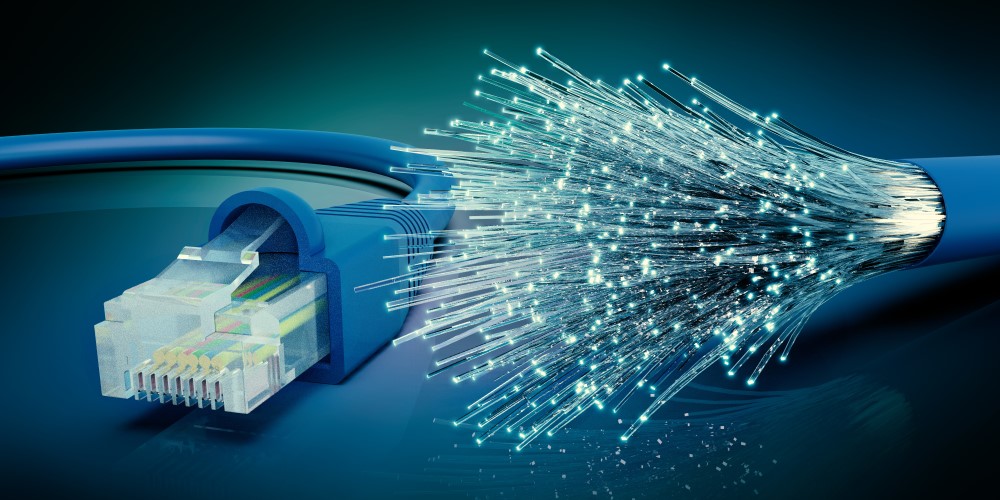
Fibre optic technology has fundamentally transformed modern communication and data transmission, offering benefits that far surpass traditional copper or coaxial cable systems. By transmitting information as pulses of light through ultra-thin glass or plastic fibres, fibre optics provide high-speed, high-capacity, and highly reliable communication channels. The adoption of this technology spans across multiple sectors, including telecommunications, internet infrastructure, healthcare, defense, and industrial monitoring.
1. Unmatched data transmission speed
One of the most significant advantages of fibre optic technology is its remarkable transmission speed. Light travels through optical fibres at approximately 200,000 kilometers per second, allowing data to move almost instantaneously across long distances. In comparison to copper cables, which transmit data via electrical signals, fibre optics experience minimal latency and almost no signal degradation over hundreds of kilometers.
This high-speed transmission is critical for modern applications such as real-time video conferencing, high-definition streaming, cloud computing, and financial transactions. For instance, businesses that rely on real-time data exchange or high-frequency trading benefit greatly from the low latency offered by fibre networks. The ability to transfer large volumes of data quickly also enables faster access to remote databases, more efficient communication between offices, and smoother operation of large-scale online platforms.
2. Exceptional bandwidth capacity
Fibre optic cables provide an unmatched level of bandwidth compared to traditional metallic cables. Bandwidth refers to the volume of data that can be transmitted over a network in a given period, and fibre optics can support data rates measured in terabits per second. This high capacity ensures that multiple users or devices can access large amounts of data simultaneously without experiencing significant slowdowns.
In practical terms, this translates to more efficient internet services for homes, businesses, and data centers. For example, internet service providers using fibre optics can offer gigabit and multi-gigabit plans to customers, enabling seamless video streaming, rapid downloads, and uninterrupted cloud service access. Fibre’s high bandwidth capacity also supports emerging technologies such as virtual reality (VR), augmented reality (AR), and Internet of Things (IoT) applications, which demand substantial data transmission to operate effectively.
3. Reliability and signal integrity
Another critical advantage of fibre optic technology is its reliability. Unlike copper cables, which are prone to signal degradation due to electrical resistance and electromagnetic interference (EMI), optical fibres transmit data through light, making them immune to external electromagnetic noise. This ensures that signals remain consistent and accurate over long distances.
Fibre optics also experience very low attenuation, meaning that light signals maintain their strength even after traveling hundreds of kilometers. This reliability makes fibre ideal for applications where consistent data quality is essential, such as telemedicine, video surveillance, or industrial control systems. Furthermore, optical fibres are resistant to environmental factors such as moisture, corrosion, and temperature fluctuations, making them suitable for underground, underwater, and harsh industrial installations.
4. Enhanced security
Data security is increasingly important in the digital age, and fibre optic technology provides a higher level of security compared to traditional cables. Intercepting or tapping into a fibre optic cable is extremely difficult because the transmission is based on light rather than electrical signals. Any attempt to tap the fibre typically causes a noticeable drop in signal quality, alerting network operators to potential breaches.
This inherent security advantage is particularly valuable for sensitive applications in government, finance, healthcare, and defense. For example, financial institutions transmitting confidential transaction data, hospitals sharing patient information, and military communications rely on fibre optic networks to prevent unauthorized access and maintain data confidentiality. Additionally, advanced encryption techniques can be applied to optical networks, further enhancing protection against cyber threats.
5. Scalability and future-proofing
Fibre optic technology is highly scalable, allowing networks to expand and adapt to growing data demands without requiring complete infrastructure overhauls. Modern optical fibres support advanced multiplexing techniques, such as wavelength-division multiplexing (WDM), which allows multiple data streams to travel simultaneously over a single fibre. This significantly increases capacity without additional physical cables.
This scalability ensures that fibre networks are future-proof, capable of handling the increasing data demands of the digital era. As new technologies emerge – such as 5G and beyond, cloud computing, artificial intelligence, and high-definition media – fibre optic infrastructure can accommodate higher data volumes and faster transmission speeds without substantial upgrades. In contrast, copper networks often reach their capacity limits quickly, requiring costly replacements or additions to meet demand.
6. Cost efficiency over time
While the initial deployment of fibre optic networks may involve higher costs than traditional copper systems, the long-term economic benefits are substantial. Fibre cables require less maintenance due to their durability and resistance to environmental damage. Signal amplifiers and repeaters are needed less frequently, reducing operational expenses over time.
Additionally, fibre networks can consolidate multiple services, such as internet, telephone, and television, onto a single infrastructure, further reducing costs for service providers and end-users. The efficiency gained from higher data speeds, reduced downtime, and long-lasting performance often offsets the initial investment, making fibre optic technology economically advantageous in the long term.
7. Applications across multiple sectors
The benefits of fibre optic technology extend beyond telecommunications.
- In healthcare, fibre optics enable minimally invasive procedures through endoscopic imaging and laser surgeries. Surgeons can transmit high-resolution images from inside the body to monitors, improving diagnostic accuracy and reducing patient recovery times.
- In industry, fibre optic sensors monitor strain, temperature, pressure, and vibration in pipelines, bridges, and buildings. Distributed sensing over long distances allows real-time monitoring, predictive maintenance, and enhanced safety, preventing catastrophic failures.
- In education and research, high-speed fibre networks support online learning platforms, virtual laboratories, and collaborative scientific research across global institutions. Students and researchers can access vast databases, conduct real-time experiments, and exchange large datasets efficiently.
- In the entertainment sector, fibre optics facilitate high-quality broadcasting, live event streaming, and online gaming, offering low-latency, high-definition experiences to consumers worldwide.
8. Environmental and practical advantages
Fibre optic technology also offers environmental benefits. Fibre cables are lightweight and occupy less physical space than copper, reducing the amount of material required for large-scale network deployment. Their efficiency in data transmission reduces the energy needed to operate networks, contributing to lower carbon emissions.
Practically, fibre optics are easier to install in dense urban areas or challenging terrains. Flexible and compact, they can be routed through conduits, under streets, or even across oceans via submarine cables without significant logistical obstacles. This flexibility allows rapid deployment of high-speed networks in both urban and rural areas, bridging the digital divide.
9. Supporting emerging technologies
Fibre optic networks are foundational to many emerging technologies. The rollout of 5G mobile networks, which requires extremely high bandwidth and low latency, relies on fibre backhaul connections to transmit data from cellular towers to core networks. Similarly, autonomous vehicles depend on high-speed, low-latency communication with cloud servers, a requirement efficiently met by fibre optics. Moreover, the integration of artificial intelligence, machine learning, and big data analytics across industries demands robust, high-capacity networks. Fibre optic technology ensures that massive data streams are transmitted reliably and quickly, enabling real-time analytics, decision-making, and automation.
Conclusion
Fibre optic technology offers a comprehensive set of benefits that have transformed global communication, commerce, healthcare, industry, and entertainment. Its unmatched speed, high bandwidth capacity, reliability, security, scalability, and long-term cost efficiency make it an essential infrastructure for the modern world. Beyond connectivity, fibre optics enable critical applications in medicine, research, industry, and defense, supporting innovation and technological advancement across sectors.
As data demands continue to grow, and emerging technologies such as 5G, autonomous systems, and AI applications proliferate, the role of fibre optics will become even more pivotal. Investing in fibre optic networks ensures that societies and industries can meet future communication requirements efficiently, securely, and sustainably. In essence, fibre optics not only connect the world today but also provide the foundation for the technological breakthroughs of tomorrow.