








































































































































































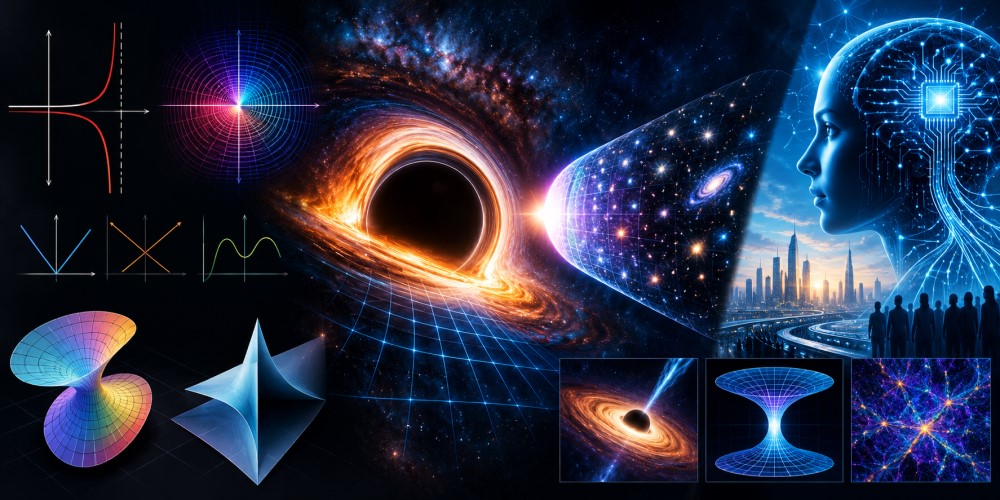
Singularity is one of those scientific terms that sounds simple but has an extraordinarily broad meaning. The basic idea is that something reaches a special condition where ordinary mathematical, physical or computational descriptions cease to work normally. Depending on the discipline, a singularity can be a point where a mathematical function becomes undefined, a region where spacetime curvature becomes extreme, a sudden change in the structure of a physical system, or a hypothetical moment when technological development becomes effectively uncontrollable.
Singularities are especially important because they reveal the limits of theories. When an equation produces infinity, an undefined quantity or a sudden qualitative transition, scientists do not necessarily conclude that nature itself contains an actual infinity. Instead, the result can indicate that the model being used has reached a boundary beyond which a more complete theory is required. This distinction is particularly important when discussing black holes and the origin of the universe.
What is a singularity?
A singularity is generally a point, location, state or condition at which the normal behaviour of a mathematical or physical system breaks down. In mathematics, it can be a point where a function is not defined or fails to possess the properties expected of it. In physics, a singularity can describe a situation in which quantities such as spacetime curvature become unbounded within a classical theory. In technological discussions, singularity has a more speculative meaning, referring to a hypothetical transition in which technological progress becomes extraordinarily rapid.
The mathematical meaning is the foundation from which many other uses of the word developed. A mathematical singularity may occur when an equation, surface or function becomes degenerate or behaves abnormally. Mathematical references classify singularities in several ways depending on the properties of the function and the surrounding region.
The important point is that a singularity is not necessarily a physical object. It may instead be a feature of a mathematical description. For example, if an equation contains a denominator that becomes zero, the equation may become undefined at that particular point. The singularity is therefore a property of the mathematical representation rather than necessarily an object sitting somewhere in the physical universe.
How does a singularity work?
A singularity works by marking a transition between ordinary behaviour and exceptional behaviour. As a system approaches the singular point, one or more quantities may become undefined, diverge toward infinity, lose differentiability, become non-unique or undergo a qualitative change. Consider the simple function:
For every value of except zero, the function is well defined. As approaches zero, however, its magnitude increases without bound. At , the expression is undefined. The point is therefore a singularity of the function. This simple example illustrates an important principle. A singularity can be understood by examining what happens as a system approaches the exceptional point.
Scientists and mathematicians ask whether the quantity remains finite, whether a limit exists, whether the function can be repaired, and whether the behaviour remains stable when the system is slightly changed. Singularity theory goes considerably further than simply identifying such points. It investigates the structure of singularities, how they form, how they can be classified and how they behave under transformations or perturbations.
What is singularity theory?
Singularity theory is a branch of mathematics concerned with exceptional points and structures in functions, mappings and geometric objects. Rather than studying only ordinary, smooth behaviour, it focuses on what happens when smoothness, uniqueness, rank or other regular properties fail. The subject has strong connections to differential topology, differential geometry, algebra, complex analysis and dynamical systems.
Topology is particularly relevant because it studies properties that remain meaningful under continuous deformation, while differential topology examines smooth structures and mappings. One of the central questions in singularity theory is this: What happens when a mathematical object ceases to behave regularly? Suppose a smooth function maps one space into another. Most points may behave regularly, meaning that small changes in the input produce predictable changes in the output.
At certain exceptional points, however, the derivative may lose rank or vanish. These are called critical or singular points depending on the mathematical setting. Singularity theory attempts to classify these exceptional behaviours and determine which characteristics are fundamental and which are merely consequences of the coordinate system used to describe them.
Regular points and singular points
The distinction between regular and singular points is essential to understanding the subject because singularity theory begins with the behaviour of ordinary points. At a regular point, the mathematical object behaves in the expected smooth manner. A curve has a well-defined tangent, a surface behaves locally like a smooth sheet, and a mapping changes predictably when its input changes.
At a singular point, something goes wrong with this regular structure. A curve may develop a cusp, two branches may cross, a surface may develop a sharp point, or the derivative of a mapping may lose rank. A simple example is the curve:
This equation describes two intersecting straight lines. At their intersection, the geometry is different from that of either line away from the crossing. The intersection can therefore be regarded as a singular feature of the curve. The same principle applies to far more complicated mathematical objects. Singularity theory provides tools for determining whether apparently different singular structures are actually manifestations of the same underlying mathematical pattern.
Types of mathematical singularities
Mathematical singularities take several forms, and their classification depends heavily on the field being considered. Complex analysis provides some of the clearest examples. For a complex function, an isolated singularity may be classified as removable, a pole or an essential singularity. These categories describe increasingly different forms of abnormal behaviour.
a. Removable singularities
A removable singularity is a point where a function is initially undefined but can be assigned a suitable value so that the function becomes well behaved. For example:
is undefined at as written. However, the limit as approaches zero is 1. If the function is defined to have the value 1 at zero, the apparent singularity disappears. This is why it is called removable: the problem can be eliminated without fundamentally changing the surrounding function.
b. Poles
A pole is a stronger type of singularity. As the input approaches the singular point, the function grows without bound. For example:
has a pole at . Unlike a removable singularity, the problem cannot be fixed simply by assigning a finite value to the function at that point. Poles can also have different orders. A pole of order roughly corresponds to the function diverging like near the singularity.
c. Essential singularities
An essential singularity is more complicated. The function does not simply approach infinity in a predictable way. Instead, its behaviour can become extraordinarily irregular as the singular point is approached. The classic example is:
at .
Near an essential singularity, complex functions can exhibit remarkably complicated behaviour. This is one reason singularities are so important in complex analysis.
Singularities in geometry
Singularities also appear in geometry when geometric objects fail to be smooth. A smooth surface resembles an ordinary flat plane when examined sufficiently closely around any point. At a singular point, that local structure can break down. A surface may develop a sharp point, cusp, self-intersection or other irregularity. Such features are important in algebraic geometry, differential geometry and topology.
The underlying idea is closely related to manifolds. A manifold is a space that locally resembles ordinary Euclidean space. Singularity theory examines what happens when that smooth local description fails. This provides a powerful conceptual framework because many objects in physics can be modelled using geometric spaces. Spacetime in general relativity, for example, is described mathematically as a four-dimensional spacetime manifold.
Singularity theory and catastrophe theory
Singularity theory is closely associated with catastrophe theory, although the two are not identical. Catastrophe theory examines how small changes in parameters can produce sudden qualitative changes in the behaviour of a system. A system may change gradually while its underlying state remains stable. As a critical parameter is reached, however, the system can suddenly jump into a different state.
Examples can be found in physical, biological, engineering and economic models. The mathematical study of these transitions is closely related to singularities and bifurcations. Wolfram MathWorld describes catastrophe theory as studying how the qualitative nature of solutions depends on parameters in equations.
The connection can be understood through the concept of stability. A small disturbance normally produces a small response. Near a critical point, however, the response can become disproportionately large. Singularity theory helps describe the mathematical structures responsible for these transitions.
What is a bifurcation?
A bifurcation occurs when changing a parameter causes the structure or number of possible states of a system to change. Imagine a physical system controlled by a parameter such as temperature. At one range of temperatures, the system may have one stable state. As the temperature passes a critical threshold, two new states might emerge or the original state might become unstable.
This type of transition is a major subject in dynamical systems. Singularity theory provides mathematical methods for understanding the exceptional structures associated with such changes. Catastrophe theory then uses these ideas to study sudden transitions in systems governed by changing parameters.
Singularities in physics
In physics, the word singularity has a more dramatic meaning because it is associated with situations where established equations cease to provide a complete description of reality. The most famous examples occur in general relativity. Einstein’s theory describes gravity not simply as a force but as the curvature of spacetime produced by matter and energy.
Under sufficiently extreme circumstances, the mathematical equations predict regions where curvature or related physical quantities become unbounded and the classical description becomes incomplete. This is why black-hole singularities are so important. They are not merely strange objects; they represent one of the clearest indications that general relativity cannot be the final theory of gravity.
Black hole singularities
A black hole forms when matter becomes compressed into a region from which, beyond the event horizon, light cannot escape to distant observers. According to classical general relativity, gravitational collapse under appropriate conditions can continue until the theory predicts a singularity.
In the simplest non-rotating black-hole solution, this singularity is associated with the centre of the black hole. It is important, however, not to imagine the singularity as an ordinary tiny ball containing an infinite amount of matter. That picture can be misleading. A singularity in general relativity is better understood as a breakdown of the spacetime description.
Certain mathematical quantities become unbounded, and the theory ceases to provide a physically complete description of what happens at that location. The Stanford Gravity Probe B educational material notes that singularities in classical general relativity correspond to situations where spacetime curvature can become infinite and the classical field equations cease to provide an adequate description.
Does a black hole singularity have zero size?
The popular description of a black-hole singularity as an infinitely small point is useful for basic explanations but should not be taken as a complete physical description. In certain solutions of general relativity, the geometry of the singularity can be more complicated. For example, the singularity associated with an idealized rotating black hole is represented mathematically as a ring rather than a simple point.
More importantly, general relativity itself does not tell us what the ultimate physical structure of the singularity should be. The theory reaches a regime where its classical description breaks down. This is one of the major reasons physicists seek a theory of quantum gravity capable of describing spacetime at extremely small scales.
The singularity at the beginning of the universe
Another famous example is the cosmological singularity associated with the Big Bang. It is common to hear that the universe began as an infinitely small point containing all matter and energy. This is an oversimplification. The Big Bang model describes the early universe as an extremely hot, dense state from which the universe expanded and cooled. When classical general relativity is extrapolated backward far enough, it can produce a singularity in the mathematical description.
This does not necessarily mean scientists know that the entire universe literally existed as a physical point of infinite density. Instead, the singularity may indicate that classical general relativity cannot be extended indefinitely backward in time. The earliest stage of the universe is therefore expected to require physics beyond our current classical theories.
What causes a physical singularity?
In classical physics, singularities can arise when the mathematical evolution of a system reaches a state in which the governing equations become undefined or produce divergent quantities. In general relativity, gravitational collapse is one route. If sufficient matter becomes concentrated and the conditions required by the theory are satisfied, spacetime can become geodesically incomplete.
The term geodesic incompleteness is particularly important. A geodesic is the general-relativistic equivalent of the straightest possible path through spacetime. If a geodesic cannot be extended indefinitely within the spacetime described by the theory, this can signal the presence of a singularity.
The singularity theorems developed by Roger Penrose, Stephen Hawking and others showed that singularities are not merely peculiar features of highly artificial mathematical solutions. Under broad physical assumptions, gravitational collapse and cosmological evolution can lead to geodesic incompleteness.
Are physical singularities real?
Whether singularities are physically real in the literal sense remains an open question. There is a crucial difference between saying that a theory predicts a singularity and saying that nature contains an actual infinity. When a mathematical model produces infinity, it can mean that the quantity genuinely becomes arbitrarily large within the theory. But it can also mean that the theory is being applied outside the domain where it is valid.
A familiar analogy is classical fluid mechanics. A simplified model can predict an infinite value under certain circumstances even though the real physical system contains additional effects that prevent such an infinity. Many physicists therefore suspect that a future theory of quantum gravity will replace classical singularities with a different physical description. Exactly what that description will be remains unknown.
General relativity versus quantum mechanics
The problem of singularities exposes a fundamental tension in modern physics. General relativity is extraordinarily successful at describing gravity, planets, stars, galaxies, black holes and the large-scale structure of the universe. Quantum mechanics, meanwhile, successfully describes matter and interactions at microscopic scales.
The difficulty arises in environments where both theories are expected to matter simultaneously, particularly at extremely high densities and tiny length scales. Classical general relativity predicts singular behaviour. Quantum mechanics suggests that physical quantities should be treated according to quantum principles.
A complete theory of quantum gravity would need to reconcile these descriptions. Researchers have proposed several approaches, including string theory, loop quantum gravity and other frameworks. None has yet achieved universal experimental confirmation as the definitive theory of quantum gravity.
The Planck scale and singularities
The Planck scale represents an extraordinarily small regime where quantum gravitational effects are expected to become important. The Planck length is approximately:
At such scales, the familiar classical concept of smooth spacetime may cease to be adequate. This is why physicists generally avoid claiming that an infinitely dense physical point definitely exists inside a black hole. The equations of classical general relativity may simply be extrapolated beyond the regime where quantum effects become unavoidable. The possibility that quantum gravity replaces mathematical infinities with finite physical quantities is widely discussed, although the actual mechanism remains unknown.
Naked singularities
A particularly interesting theoretical possibility is a naked singularity. A black-hole singularity is normally expected to be hidden behind an event horizon. If a singularity were visible to distant observers, it would be described as naked. The idea is controversial because it challenges the notion that singularities produced by gravitational collapse should remain hidden.
The cosmic censorship conjecture, associated with Roger Penrose, proposes in broad terms that physically realistic gravitational collapse should not normally produce singularities visible from infinity. However, cosmic censorship is a conjecture rather than a proven universal law. This means that the question of whether nature permits naked singularities remains an important subject of theoretical research.
Singularity and infinite density
One of the most common misconceptions is that a singularity simply means infinite density. Density is mass divided by volume:
If a classical model causes the effective volume to approach zero while the mass remains finite, the mathematical density can approach infinity. But this does not necessarily mean that an infinitely dense physical object exists. It may instead indicate that the assumptions used to calculate the density are no longer valid. In general relativity, the more fundamental issue is often the behaviour of spacetime geometry and geodesics rather than density alone.
Singularity in complex analysis
Complex analysis provides one of the most elegant mathematical settings in which singularities can be studied. A complex function can behave extremely differently near exceptional points. The classification into removable singularities, poles and essential singularities allows mathematicians to describe these behaviours precisely. The Laurent series is particularly useful because it can represent a complex function around an isolated singularity using both positive and negative powers. For example:
The pattern of negative-power terms provides information about the nature of the singularity. This framework has major applications in mathematical physics, engineering and applied mathematics. Complex analysis uses singularities to evaluate integrals, understand analytic functions and study physical systems.
Singularity in differential equations
Differential equations can also possess singular points where their usual solution methods fail or require special treatment. For a differential equation, a singular point may occur when the coefficients of the equation become infinite or otherwise cease to satisfy the conditions associated with an ordinary point.
Singular differential equations are important because many real-world systems naturally involve boundaries, discontinuities or extreme conditions. Engineers and physicists therefore need to determine whether a singularity represents a genuine physical phenomenon, an idealization, a boundary condition or a mathematical artifact.
Singularity theory in dynamical systems
Dynamical systems describe how quantities change over time. Examples range from planetary motion to population models, fluid flows, weather systems and electrical circuits. Singularity theory becomes important when the system’s qualitative behaviour changes. A system can have equilibrium points where its state remains unchanged.
Depending on parameters, those equilibrium points can appear, disappear or change stability. At critical parameter values, the system can undergo bifurcations. Studying these singular structures helps scientists understand why a system that appears stable under ordinary conditions can suddenly change behaviour after a relatively small parameter change.
Applications of singularity theory
Although singularity theory may appear abstract, its ideas have practical applications across science and engineering. In optics, singularities can occur in wave fields and influence the behaviour of light. In fluid mechanics, singular structures can appear in flows. In computer vision, singularities and critical points can help describe shapes and transformations. In robotics, singularity analysis helps identify configurations in which a robot’s movement becomes restricted or unpredictable.
Singularity theory is also relevant to control systems, geometry, material science and mathematical modelling. The broader value of the theory is that it helps researchers distinguish generic behaviour from exceptional behaviour. A system can be complicated in countless ways, but singularity theory seeks to identify the fundamental structures that explain important transitions.
The technological singularity
The technological singularity is completely different from a mathematical or gravitational singularity, although the same word is used because the concept involves a boundary beyond which prediction becomes extremely difficult. The technological singularity is a hypothetical future point at which technological progress accelerates dramatically, potentially because artificial intelligence systems become capable of improving their own capabilities or contributing substantially to the development of increasingly advanced systems.
The idea is closely associated with discussions about artificial general intelligence, recursive self-improvement, automation, biotechnology, robotics and computational progress. Unlike mathematical singularity theory or the singularities predicted by general relativity, the technological singularity is not an established physical phenomenon. It is a speculative scenario about the future.
How the technological singularity could work
A hypothetical technological singularity might begin with artificial intelligence becoming capable of performing increasingly sophisticated research and development. Suppose an AI system can design a more capable AI system. The improved system could then design an even more capable version. If each generation substantially accelerates the development of the next, technological progress could become extremely rapid. This is sometimes described as a feedback loop:
If the process became sufficiently rapid, humans might struggle to predict what technologies would exist only a short time later. However, this scenario depends on many assumptions. AI systems may encounter hardware limitations, energy constraints, data limitations, economic barriers, diminishing returns or fundamental scientific bottlenecks. Therefore, the technological singularity should be treated as a hypothesis rather than a guaranteed event.
Is the technological singularity inevitable?
No. There is no scientific law requiring humanity to reach a technological singularity. Technological development depends on many variables, including economics, scientific discoveries, regulation, energy availability, computer hardware, social institutions and human decisions. Even if artificial intelligence becomes extremely capable, there is no guarantee that capability will increase exponentially forever. Consequently, claims that the singularity will definitely occur at a particular date should be treated cautiously.
Singularity versus black hole event horizon
Another common misunderstanding is the assumption that the singularity and event horizon are the same thing. They are not. The event horizon is a boundary associated with a black hole. Once an object crosses the event horizon of an idealized black hole, it cannot send information back to distant observers through ordinary outward-moving light signals.
The singularity is associated with the breakdown of the classical spacetime description deeper inside the black hole. The two concepts are therefore fundamentally different. The event horizon is a causal boundary, whereas the singularity represents a limit or breakdown in the classical solution.
Can we observe a singularity?
Directly observing a singularity is extraordinarily problematic. If a singularity is hidden behind an event horizon, information from the singular region cannot escape to distant observers through ordinary causal paths. Astronomers can therefore observe effects produced by black holes without directly seeing the singularity itself.
Scientists can observe matter orbiting black holes, gravitational effects, accretion disks, jets and gravitational waves produced by black-hole interactions. These observations provide evidence for the existence and properties of black holes, but they do not amount to a direct photograph of a singularity.
What happens at a singularity?
The honest scientific answer is that we do not know what ultimately happens at a physical singularity. Classical general relativity predicts that certain quantities diverge or that spacetime becomes geodesically incomplete. At that point, the classical equations no longer provide a complete physical description. A future theory of quantum gravity may reveal that there is no literal infinity at all.
Instead, spacetime may possess a fundamentally different microscopic structure. Some speculative theories propose quantum cores, spacetime fluctuations, quantum geometric states or other structures. These ideas remain theoretical and should not be presented as established descriptions of what lies inside a black hole.
Why are singularities important?
Singularities are important because they expose the limits of our theories. A scientific theory becomes particularly interesting when it tells us not only how nature behaves under ordinary circumstances but also where its own mathematical description stops working. Black-hole singularities demonstrate that general relativity, despite its extraordinary success, is probably incomplete as a fundamental description of nature.
Mathematical singularities, meanwhile, provide powerful information about the structure of functions and geometric objects. Technological singularity scenarios challenge society to consider what could happen if technological progress becomes substantially faster than existing institutions can adapt. In all three cases, singularities represent boundaries of understanding.
Common misconceptions about singularity
Several popular misconceptions make singularities more mysterious than they need to be. The first is that every singularity is an infinitely small physical object. This is false. In mathematics, a singularity can simply be a point where a function is undefined or fails to behave regularly. The second is that every singularity contains infinite matter. Again, this is not necessarily true. Mathematical infinity can indicate that a theory has reached its limits.
The third is that the Big Bang was simply an explosion occurring at one point in pre-existing space. Modern cosmology instead describes the expansion of space itself from an extremely hot and dense early state. The fourth is that technological singularity is an established prediction. It is not. It is a hypothetical scenario whose likelihood, timing and ultimate consequences remain uncertain.
The deeper meaning of singularity
The most useful way to understand singularity is not as a strange object but as a boundary of ordinary description.
- In mathematics, the boundary appears when functions or geometric structures stop behaving regularly.
- In complex analysis, singularities determine how functions behave near exceptional points.
- In differential equations, they can mark locations where standard solution methods fail.
- In catastrophe theory, they help describe abrupt changes in systems.
- In general relativity, singularities indicate where the classical description of spacetime becomes incomplete.
- In cosmology, the extrapolation of classical equations toward the earliest universe leads to a singular boundary.
- In technology, the word describes a hypothetical point beyond which technological change could become extremely difficult for humans to predict.
These applications are different, but they share a common conceptual thread: something reaches a regime where ordinary expectations cease to provide a complete description.
The future of singularity research
The future study of singularities is likely to remain closely connected with some of the deepest questions in mathematics and physics. In mathematics, researchers continue to investigate increasingly complicated singular structures, their classifications, their stability and their relationships to topology and geometry. In physics, one of the greatest goals is to determine what replaces classical singularities in a successful theory of quantum gravity.
The answer could fundamentally change our understanding of spacetime, black holes and the early universe. Black holes are particularly valuable because they provide natural environments in which gravity becomes extremely strong. Observations of gravitational waves, black-hole environments and other astrophysical phenomena provide increasingly sophisticated tests of gravitational theories.
The technological meaning of singularity will also continue to generate debate as artificial intelligence becomes increasingly capable. Whether technological development eventually produces a genuine runaway feedback process remains uncertain, but the question raises important issues concerning economics, science, governance, safety and the future of human civilisation.
Conclusion
Singularity is not one phenomenon but a broad scientific and mathematical concept describing exceptional conditions in which normal behaviour breaks down or a particular theory reaches its limits. In mathematics, singularity theory provides rigorous tools for analysing exceptional points in functions, mappings and geometric structures. It is closely connected to topology, differential geometry, dynamical systems, bifurcation theory and catastrophe theory.
In physics, singularities are most famously associated with black holes and cosmology. General relativity predicts that under certain conditions spacetime can become geodesically incomplete and that curvature can become unbounded. This does not necessarily prove that nature contains literal points of infinite density; instead, it strongly suggests that classical general relativity cannot provide the complete description of reality in such extreme regimes.
The technological singularity represents a different idea altogether. It describes a hypothetical future in which technological development, potentially driven by increasingly capable artificial intelligence, becomes so rapid that conventional methods of predicting social and technological change cease to be reliable.
Ultimately, the importance of singularities lies in what they reveal. They identify places where familiar descriptions become inadequate and where deeper principles may be required. A mathematical singularity can reveal hidden structure in an equation; a gravitational singularity can expose the limits of classical physics; and a technological singularity can force society to consider the consequences of unprecedented technological acceleration.
For this reason, singularities are not simply points where science stops. They are also signposts pointing toward the questions that science has yet to answer. The study of singularities therefore remains one of the most fascinating intersections between mathematics, physics, cosmology, computer science and the broader human attempt to understand the limits of knowledge.